Greece
Cartes Postales from GreeceGreece is the novel’s central setting and more than a backdrop: it begins as a luminous image pinned to a wall, becomes an unpredictable country encountered on the road, and ends as a place in which grief can loosen its hold. For Ellie Thomas, the postcards make Greece a promise of escape; for the man whose journey they record, its landscapes and people first sharpen his pain, then help him want to live again. Their separate routes eventually converge in Athens, where Greece’s beauty and its difficulties remain present together.
The Greece of the postcards
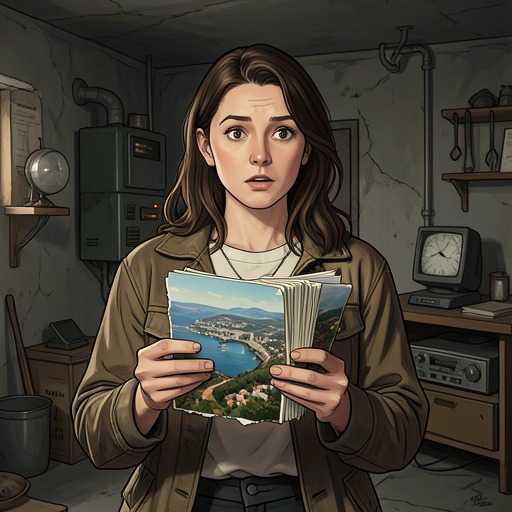
Before Ellie visits, she knows Greece through the pictures arriving week after week, all signed with the initial A. She pins them to a corkboard in her flat in Kensal Rise, where skies, sea, boats, and whitewashed buildings with blue shutters accumulate into a mostly blue-and-white mosaic. As the cards arrive, their place names become a map of a country she has never seen. The arrangement turns a blank domestic wall into a view outward, and the images gradually claim a place in her imagination and daily life.
That imagined country is also a counter-image to Ellie’s routine. In winter she leaves for work before dawn and returns at seven, keeping the curtains closed; her job selling advertising space has never felt like the route into publishing she hoped it might be. From London, the postcards seem to offer light, colour, and distance from the life she expected. Their appeal lies partly in what they cannot show: they offer snapshots, not the scents and sounds of Greece, and Ellie knows the pictures may exaggerate. When the cards stop, their absence makes the question urgent: whether the promised skies and translucent light exist beyond the frame.
From imagined map to travelled country
Ellie’s decision to go is spontaneous but has been gathering force for months. She checks a passport last used on a trip to Spain, finds an inexpensive flight to Athens, and chooses a week’s half-board near Nafplio for one hundred and twenty pounds. She is not an experienced or adventurous traveller, and the modest plan matters: Greece is no longer only a picture to contemplate but a place she can reach. On the morning she leaves for Athens, a notebook arrives, carrying the account of a man’s journey through the country. Her own departure and his written travels thus meet at the threshold between looking at Greece and entering it.
The notebook’s route is longer and less settled. In October 2015, the narrator begins travelling in the Peloponnese, carrying grief that the landscape’s fullness does not soothe. Later, after leaving a village, he buys supplies and a postcard, writes to the person who is absent from his life, and sends it without expecting a reply. He sits in the car for at least an hour before managing to drive east, with no fixed destination. His journey then unfolds through encounters: people speak to him, he listens and takes notes, and their stories fill some of the silence left by his loss. He admits that some tales may be fabricated or exaggerated, leaving their truth for the reader to judge.
Hospitality and the limits of the postcard view
The road repeatedly tests the difference between a picturesque destination and a welcoming one. After Thessaloniki, the narrator makes his way down the east coast through Katerini, Larissa, Volos, and Lamia. Near Lamia he finds a beautiful fishing village reached by a rough track through meadows and ripening crops. Oranges and lemons lie ungathered; a sheltered harbour holds colourful boats, and a sandy cove sits beneath pines. Yet the village’s apparent abundance offers little welcome to a foreign visitor. Restaurant customers respond dismissively when he asks for a table, no shop sells ordinary beach supplies or postcards, and there are no hotels, pensions, or rooms for rent.
His unease becomes more legible after he leaves. Fifty kilometres away, in a workaday town, a two-star hotel costs twenty-five euros and offers crisp linen, a comfortable bed, and excellent coffee. Its owner cheerfully brings him a second espresso and asks about his journey. When the narrator names the village, the owner reacts with disbelief and says that something terrible is said to have happened there. The contrast is not simply between beauty and ugliness: the polished scene had concealed a history that the traveller could not read from its harbour or shoreline. Greece’s welcome, or its absence, emerges through people’s gestures and through stories that complicate the view.
Ikaria, mortality, and the return of desire
On Ikaria, the narrator encounters another relation between place and life. The island is described as a vast rock in the sea, shaped by hardship from invaders and the elements. During a religious festival he drinks and feasts late into the night, then finds himself drawn into a dance circle. The dancers move clockwise, slowly and rhythmically; as the music quickens, the others remain patient while he tries to learn the steps. The experience of being included changes the meaning of being alone: he feels himself part of a single moving body rather than an isolated traveller.
He stays above an empty shop in Evdilos, swims in a hot spring, talks with strangers, and visits Ariadne again. Around this part of the journey, the book places mortality beside acts of defiance: death notices, cemeteries, and roadside memorials are common sights, while people answer finitude by drinking, dancing, and loving. The mythic stories told on the island also turn grief toward the possibility of mending. Most decisively, the narrator recognizes that he wants to live into old age rather than not live at all. Greece has not erased his loss or made his earlier suffering unreal; it has helped him imagine joy as something not dependent on another person completing him.
Athens as destination and counter-image
After forty weeks on the road, the narrator stops travelling and decides to stay in Athens. The city does not reproduce the postcard ideal: traffic is terrible, paving stones are broken, shops are boarded up, and graffiti is widespread. Strikes and demonstrations can halt daily life and turn violent. He observes the anger of pensioners whose payments have been cut, young people without work, and people whose earnings are consumed by taxation; refugees from war-torn countries camp in the squares with almost nothing. This is Greece as a difficult present, not a scenic promise.
Yet Athens also gives him a view that gathers the country’s enduring attractions into one lived place. From his roof terrace he can see the sea, mountains, and Acropolis of Athens, watch ferries crossing toward the islands, and follow sunsets, sunrises, stars, and the moon. A rainbow after a storm reminds him of what he sees as the country’s indestructible spirit. He also finds hospitality and storytelling surviving amid hardship. In September 2016, Ellie and the narrator sit together beneath the moon and stars. Their meeting brings the postcard trail and the notebook journey into the same setting: Greece has given him an experience that keeps him there, while the postcards and stories have helped bring Ellie to that moment. The country remains both image and reality, but by the end its significance rests less on the promise of escape than on the lives and connections made within it.